

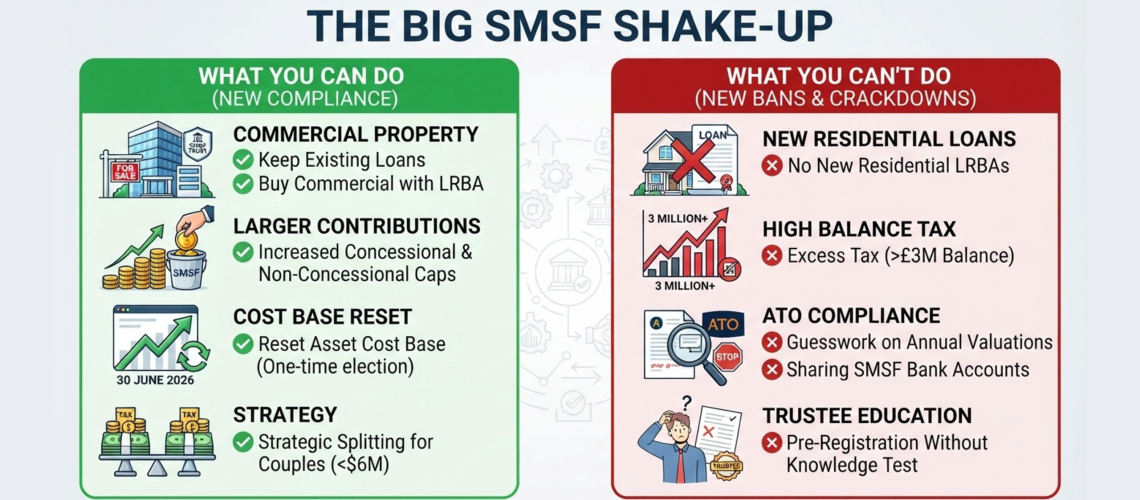
The landscape for Self-Managed Super Funds (SMSFs) has completely shifted. Recent legislative updates have introduced some of the most dramatic changes to superannuation tax, property borrowing, and compliance rules in nearly two decades.
To help you navigate these updates without triggering harsh penalties, we have broken down exactly what your SMSF CAN and CAN’T do moving forward.
1. Property & Borrowing (LRBAs)
The rules around using Limited Recourse Borrowing Arrangements (LRBAs) to purchase property inside super have been fundamentally rewritten.
🟢 What You CAN Do:
- Keep existing residential property loans: If your SMSF had an active residential property LRBA or a binding purchase contract in place before 10 August 2026, it is grandfathered. You CAN continue making repayments or even refinance the existing loan.
- Buy commercial property with a loan: The ability to use an LRBA to buy “business real property” (like offices, warehouses, or medical suites) remains completely legal.
- Buy residential property outright: If your fund has enough cash to buy a residential investment property entirely upfront without borrowing, you CAN still do so.
- Claim full negative gearing benefits: SMSFs were explicitly carved out of personal negative gearing restrictions. Your fund CAN still offset rental property losses against other fund income.
🔴 What You CAN’T Do:
- Take out new residential property loans: As of 10 August 2026, new residential LRBAs are permanently banned. You CAN’T use a new bare trust or loan structure to purchase residential real estate.
2. High-Balance Super Caps (Division 296 Tax)
The highly publicised “$3 Million Super Tax” (Division 296) officially commenced on 1 July 2026. However, significant last-minute amendments changed how it works.
🟢 What You CAN Do:
- Breathe a sigh of relief on unrealised gains: Following severe backlash, the government dropped the taxation of unrealised paper capital gains. You CAN rest assured that you will only be taxed on realised earnings (e.g., received rent, dividends, interest, and capital gains on assets actually sold).
- Reset your asset cost base: To protect your previous capital growth from being unfairly taxed, your SMSF CAN opt-in to reset the cost base of its assets to market value as of 30 June 2026 for Division 296 purposes.
- Pay the tax out of pocket or from the fund: If you breach the threshold, you CAN choose whether to pay the Division 296 bill using your personal cash or have the money released from your super fund.
- Hold up to $6 million per couple tax-concessionally: Because the thresholds are assessed per individual, a couple CAN strategically split balances so each stays under the limit.
🔴 What You CAN’T Do:
- Avoid extra tax if your individual balance exceeds $3 million: If your Total Superannuation Balance (TSB) crosses the $3 million mark, you CAN’T avoid a combined effective tax rate of 30% on the earnings of that excess slice. (Note: Balances over $10 million face a 40% effective tax rate).
- “Cherry-pick” which assets get a cost-base reset: If you opt for the 30 June 2026 cost-base reset, you CAN’T choose individual assets. It is a blanket, fund-wide election that applies to all your assets.
3. Contribution Caps & Tax Offsets
While taxes went up for ultra-high balances, everyday contribution limits saw a welcoming boost.
🟢 What You CAN Do:
- Contribute more to super: Thanks to indexation, you CAN now contribute up to $32,500 annually in concessional (taxed) contributions.
- Make larger lump-sum contributions: The non-concessional (tax-free) cap has increased to $130,000 per year. Under the bring-forward rules, you CAN contribute up to $390,000 in a single year if eligible.
- Keep your 1/3rd CGT discount: Complying super funds were excluded from personal capital gains tax overhauls. Your SMSF CAN still claim the 33.3% CGT discount on assets held longer than 12 months, keeping the effective tax rate at 10% (or 0% in pension phase).
🔴 What You CAN’T Do:
- Use personal tax structures to match super benefits: With discretionary trusts facing a new 30% minimum tax and personal CGT discounts getting slashed from July 2027, you CAN’T easily replicate the tax-shelter benefits of an SMSF through personal names or standard family trusts anymore.
4. ATO Compliance & Fund Governance
The ATO has officially launched a strict regulatory crackdown on SMSF mismanagement, meaning governance standards are higher than ever.
🟢 What You CAN Do:
- Restructure old legacy pensions: Trustees stuck in restrictive, older pension products (like lifetime or market-linked pensions) CAN utilise a special 5-year window to review, restructure, and simplify their super phase.
🔴 What You CAN’T Do:
- Skip your annual market valuations: You CAN’T guess or roll over the value of your fund assets year after year. The ATO requires strict, documented evidence of market value for all assets as of 30 June every single financial year.
- Set up a fund without passing a test: If you are registering a new SMSF, you CAN’T simply sign the papers blindly. New rules mandate pre-registration trustee education and a mandatory knowledge test to ensure you understand your legal responsibilities.
- Share standard bank accounts: To combat fraud, you CAN’T use a generic account; your SMSF must use a uniquely identifiable SMSF bank account.
What should you do next?
The strategy that worked for your SMSF last year might not be the right path forward today. Whether you need to model your Division 296 tax exposure, look into commercial property options, or ensure your annual valuations are bulletproof against the ATO crackdown, getting expert advice is non-negotiable.